
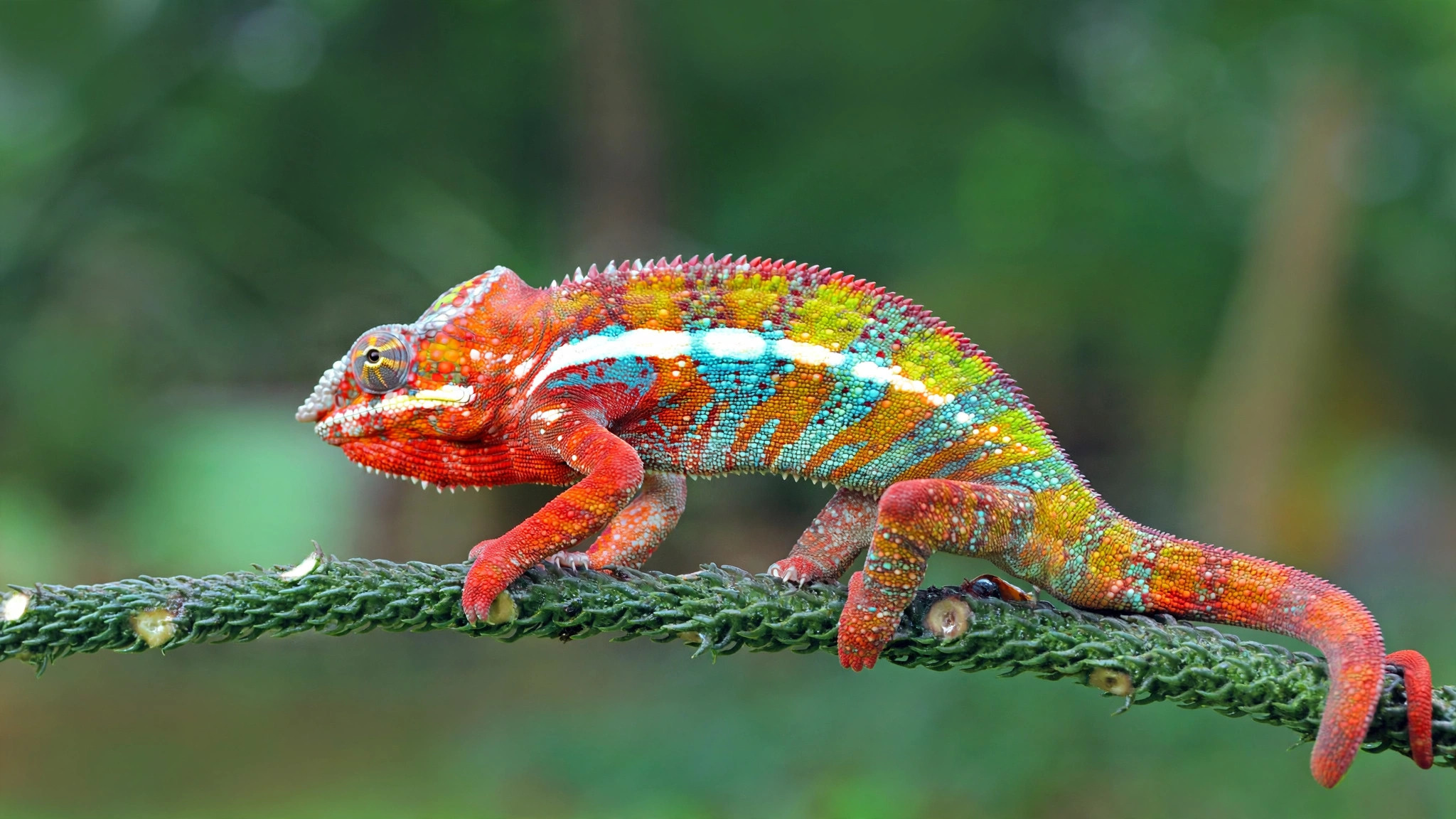
Eyes swiveling independently, a tongue striking faster than thought, skin shifting through the rainbow — chameleons are nature’s great illusionists. Anyone searching for a wallpaper with living color will find it here, in lizards that rewrote the rules of how an animal can look. This guide explores the finest chameleon styles, from panther chameleons to veiled giants, and why these color-shifting marvels make such captivating backgrounds.
Masters of Disguise
Chameleons are evolution’s artists: color-changing skin, zygodactyl feet, and ballistic tongues in one improbable package. Their image carries pure wonder — the animal as illusionist, the lizard as rainbow. Few creatures photograph like a special effect that happens to be real.
As wallpapers, chameleons deliver living color. Shifting hues, textured skin, and alien eyes make backgrounds of natural magic. These are screens for people who appreciate the extraordinary.
Signature Chameleon Styles
Four styles cover the family’s range, from raw color to frozen action. Wildlife wallpaper fans often collect across species, pairing reptile portraits with an ultra HD light lion wallpaper for the mammal side of the shelf. Each chameleon style below earns its place differently.
- Panther chameleons — the most colorful reptiles on Earth
- Veiled giants — helmeted casques and impressive size
- Eye portraits — independently moving turret eyes in macro
- Tongue strikes — the ballistic hunt, frozen mid-launch
Panther Chameleons
Panthers are the showstoppers: Nosy Be blues, Ambilobe reds, the most colorful reptiles on Earth. Locale variations — different islands, different palettes — are the collector’s joy. The colors, in these wallpapers, are localized and unmistakable.
Veiled Giants
Veiled chameleons are the casqued kings, helmeted heads atop impressive size. Their home in Yemen’s terraced highlands gives these images their context. The casque reads as a crown, and the giant wears it well.
Eye Portraits
The turret eyes are the chameleon’s strangest feature: independently moving, with 360-degree vision and an alien gaze. Macro portraits reward the detail — granular scales and the casque’s ridges up close. Readers who favor a dynamic white lion wallpaper for its stare will find a stranger one here.
Tongue Strikes
The tongue strike is pure ballistics: a lightning launch, prey captured, reputedly the fastest muscle in nature. High-speed photography freezes the invisible, the tongue extended at full reach. These action wallpapers show the hunt at its most improbable.
Giants, Pygmies, and Horns
The Jackson’s chameleon is the family’s triceratops: three horns, a casque, and a home in the Kenyan highlands. Introduced populations thriving in Hawaii add ecological complexity to its story. The highland specialist, gone tropical, stays prehistoric in looks.
At the other extreme, the pygmy world of Brookesia turns the leaf into a world. These miniature chameleons perfect camouflage as dead leaves come alive, and the micro-endemic species with single-mountain ranges are the most vulnerable of all. The tiny, in these images, is treasured.
The Parson’s chameleon is the family’s summit: Madagascar’s king and the largest by weight, moving with unhurried dignity. Its longevity is remarkable, its slow life measured in years that become the true jewels of these portraits. The majesty, quite simply, endures.
The flap-necked chameleons of the African savannas make the common spectacular, flaps extended and colors flaring. Garden visitors bring the display home, rainbows on suburban fences. The ordinary, given a closer look, turns extraordinary.
The Color’s Science and the Chameleon’s Grip
The color is physics: guanine nanocrystals whose lattice spacing shifts to produce structural color. It is also language, since dominance displays, courtship colors, and emotional hues let the skin speak. The mood, quite literally, becomes the palette, and each display is the animal speaking in color.
Habitat portraits deserve a place in any serious set: Madagascar’s forests, Yemen’s highlands, and branches treated as entire worlds. The chameleon is the forest’s jewel and the branch its throne. A collection without the habitat misses the context that makes the disguise necessary.
The grip completes the design: zygodactyl toes embracing the branch, opposed and secure, with a prehensile tail as a fifth limb and anchor. The homes behind these portraits — Madagascar’s forests, Yemen’s highlands — give the jewel its throne. Conservation gives the images urgency, as habitat loss and the pet trade threaten the jewel.
The chameleon’s lesson is written into its body: change as survival, color as communication, stillness as strategy. It does not hurry, it does not hide its feelings, and it changes when the moment requires. As the rainbow’s keeper, it keeps the spectrum safe in its skin.
Curating Your Rainbow
Build your collection by species: panthers for the color, veileds for the majesty, eyes for the alien, strikes for the action. Four palettes, one master of disguise. The branch is steady; the colors are shifting.
Choose your chameleon, set it as your background, and keep a little of that living color in your day. Some wallpapers decorate; chameleons transform — one nanocrystal at a time. The disguise, revealed, is the masterpiece.
Related posts:



Collections like this one connect to a bigger majestic-animals library — Sloth Wallpapers: Slow Living Icons is a good thread to pull next.
Share this page with a friend who is hunting for a fresh background.

