
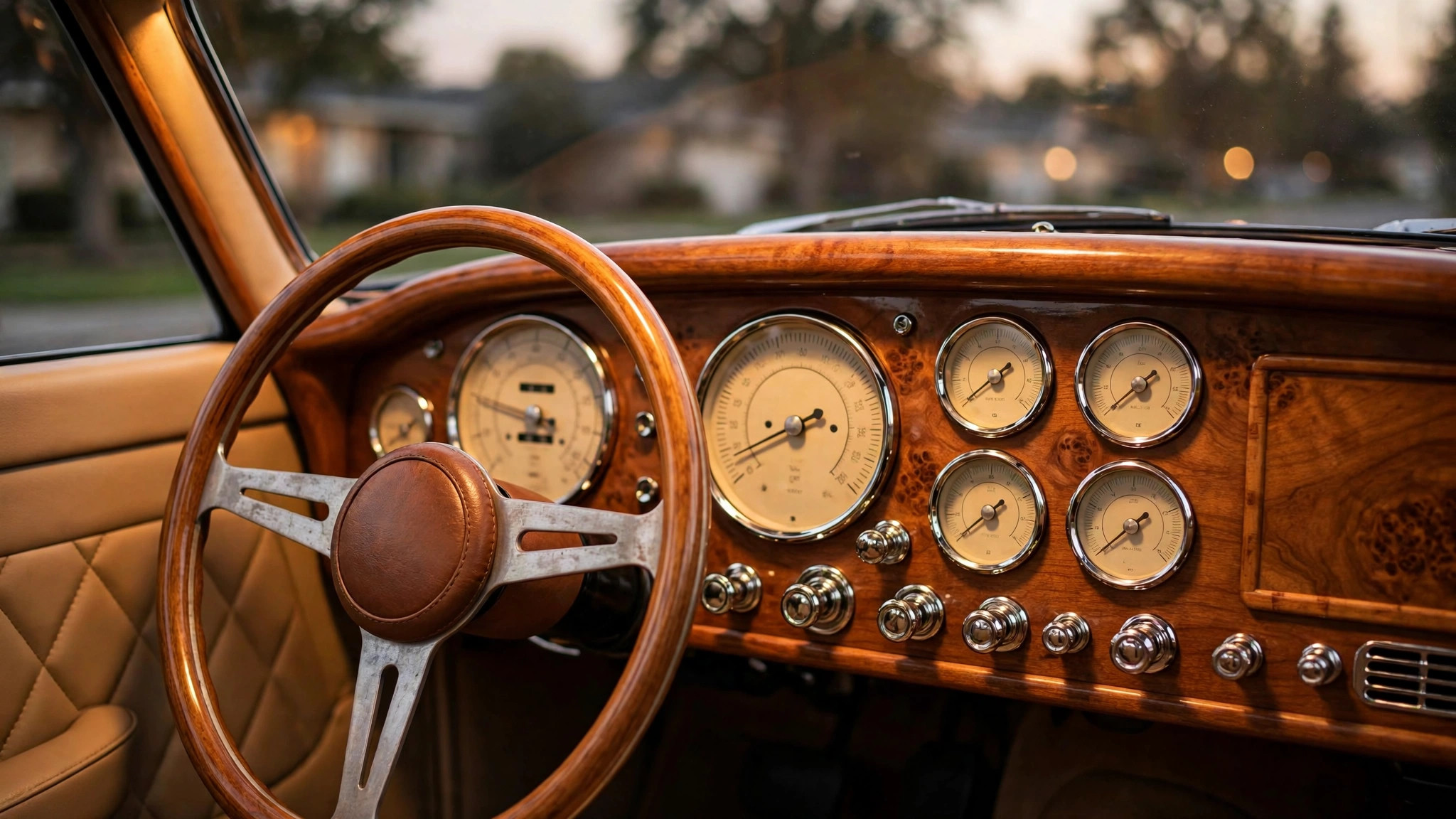
A wood-rimmed wheel, cream-faced gauges, and toggle switches like a Spitfire’s cockpit made the classic car dashboard the driver’s sanctuary. For anyone who loves driving as a tactile craft, classic car dashboard wallpapers capture analog cockpits from the era when driving was mechanical and gloriously unfiltered. This guide explains who built these cockpits, what details define them, why they feel so evocative on screen, and how to curate a set from British roadsters to American muscle.
Analog Cockpits by Nation
Before screens, there were dials, with a sweeping speedometer needle, a tachometer redline, and an oil pressure gauge’s honest flicker. Every instrument was mechanical, and every reading was earned by gears and springs. That tactility is the soul of the classic dashboard, connecting driver to machine by physics rather than software. As wallpapers, the wood, chrome, and leather deliver nostalgic craftsmanship from a more deliberate age.
British Roadsters
The MGs and Triumphs set the British formula with wood dashboards, Smiths gauges, and toggle switches. These wallpapers present the cockpit as a gentleman’s club, all walnut and chrome, seen from the driver’s seat. Patina gives the images their soul, in worn wood, faded numbers, and switches polished by decades of fingers. The dashboard reads as the car’s diary, with every mark standing for a mile.
American Muscle
The Mustangs and Camaros take the American approach, with hooded gauges, a Hurst shifter, and a no-nonsense layout. These wallpapers show the cockpit as a weapon, all business and bravado. The thunder is tamed by toggles, and the layout keeps its focus on driving. In context, the muscle cockpits balance the romance of wood with a harder, more direct character.
Italian Exotics and German Precision
The Ferraris and Lamborghinis bring Veglia gauges and a gated shifter, making the driver’s focus material. These wallpapers treat the cockpit as theater and driving as drama, proving that function can be beautiful. Readers who want the marque story behind those dials can explore Ferrari history, models, and racing legacy alongside the cockpit views.
The Porsches and Mercedes answer with five-dial clusters, perfect ergonomics, and engineering as art. German wallpapers present the cockpit as an instrument and driving as science, rendered gauge by gauge.
The Language of Gauges, Wood, and Chrome
Each dial tells a story, from the speedometer’s optimism and the tachometer’s warning to the fuel gauge’s honesty and the temperature gauge’s temperament. Gauge-focused wallpapers celebrate these vital signs in mechanical form. Typography matters just as much, in the fonts, numerals, and redlines that make gauge faces a form of industrial art. The great faces photograph magnificently because their design was always meant to be read at a glance.
The needle’s sweep is the analog age’s progress bar, arcing from zero to an optimistic maximum without ever needing a software update. Great clusters from Jaeger, Smiths, and VDO show the era’s information design at its best. Speed, revs, fuel, and temperature are all present together, as a mechanical data center. Cluster portraits reward close viewing, because calibration and layout carry as much character as speed itself.
Materials complete the picture, in walnut veneers, polished aluminum, and chrome bezels. Material wallpapers show the dashboard as craft, shaped by the woodworker’s art and the metalworker’s pride. Restoration keeps that craft alive through re-veneered dashes and re-chromed bezels. The dashboard becomes the restorer’s canvas, renewed coat by coat.
Details worth looking for in a strong dashboard wallpaper include:
- Cream-faced gauges with classic typography, numerals, and redlines
- Walnut veneers, polished aluminum, and chrome bezels with visible patina
- Wood-rimmed wheels, horn-button badges, and aircraft-style toggle switches
- Rows of labeled switches and warning lights arranged as a command center
Wheels, Toggles, and Restoration
The wood-rimmed wheel is the driver’s primary contact, from the Nardi’s elegance and the Moto-Lita’s grip to banjo spokes’ artistry. Wheel-focused wallpapers honor the hands’ home and the car’s soul, worn smooth by decades of palms. Horn buttons act as jewelry at the center, carrying the marque’s badge at the fingertips. The wheel becomes the car’s handshake, and its patina is the most touched history in the cabin.
Aircraft-style toggles bring metal batons, a satisfying click, and labels in classic script. Switch-focused wallpapers celebrate the finger’s joy and mechanical certainty, an interface that never crashed. Switch panels gather rows of toggles and warning lights into the dashboard’s jewelry box. Panel portraits present control as art, organized, labeled, and ready.
Restoration wallpapers show re-veneering in progress, with old wood stripped, new walnut applied, and lacquer built in coats. The before-and-after turns the dull glorious, with the dashboard as canvas and wood as medium. Gauge rebuilding restores faces, services mechanisms, and recalibrates needles to keep instruments honest. Workshop images linger on tiny screws and careful hands as dials are brought back to life.
The Passenger’s View and Curating Your Cockpit
The passenger’s seat offers another story, from the glovebox’s secrets to the dials admired from the side. Alternative wallpapers show the cockpit’s other half, with the journey shared and the co-pilot as witness. Great road trips add maps on the dash and souvenirs accumulating along the way. The cockpit becomes the adventure’s headquarters, and the dashboard becomes the journey’s shelf.
Build a collection by nation, with British wood for romance, American muscle for bravado, Italian exotics for drama, and German precision for science. Four cockpits can represent one analog age across tactile screens. Let the dashboards own those screens, where a wood-rimmed wheel and waiting gauges still invite attention. The appeal is deliberate and unhurried, rooted in materials that reward a long look.
Classic car dashboard wallpapers endure because they show driving as craft, with hands on the wheel, eyes on the dials, and the machine as partner. The analog age is remembered in every needle, toggle, and polished bezel. Choose a cockpit, set it as a background, and keep a little of that analog soul in the day. Some wallpapers decorate, but dashboards invite you to drive, to feel, and to be present.
Related posts:



Collections like this one connect to a bigger cars library — Double-Decker Bus Wallpapers: Icons of London Streets is a good thread to pull next.
Know someone whose screen needs a refresh? Pass this link along.

