
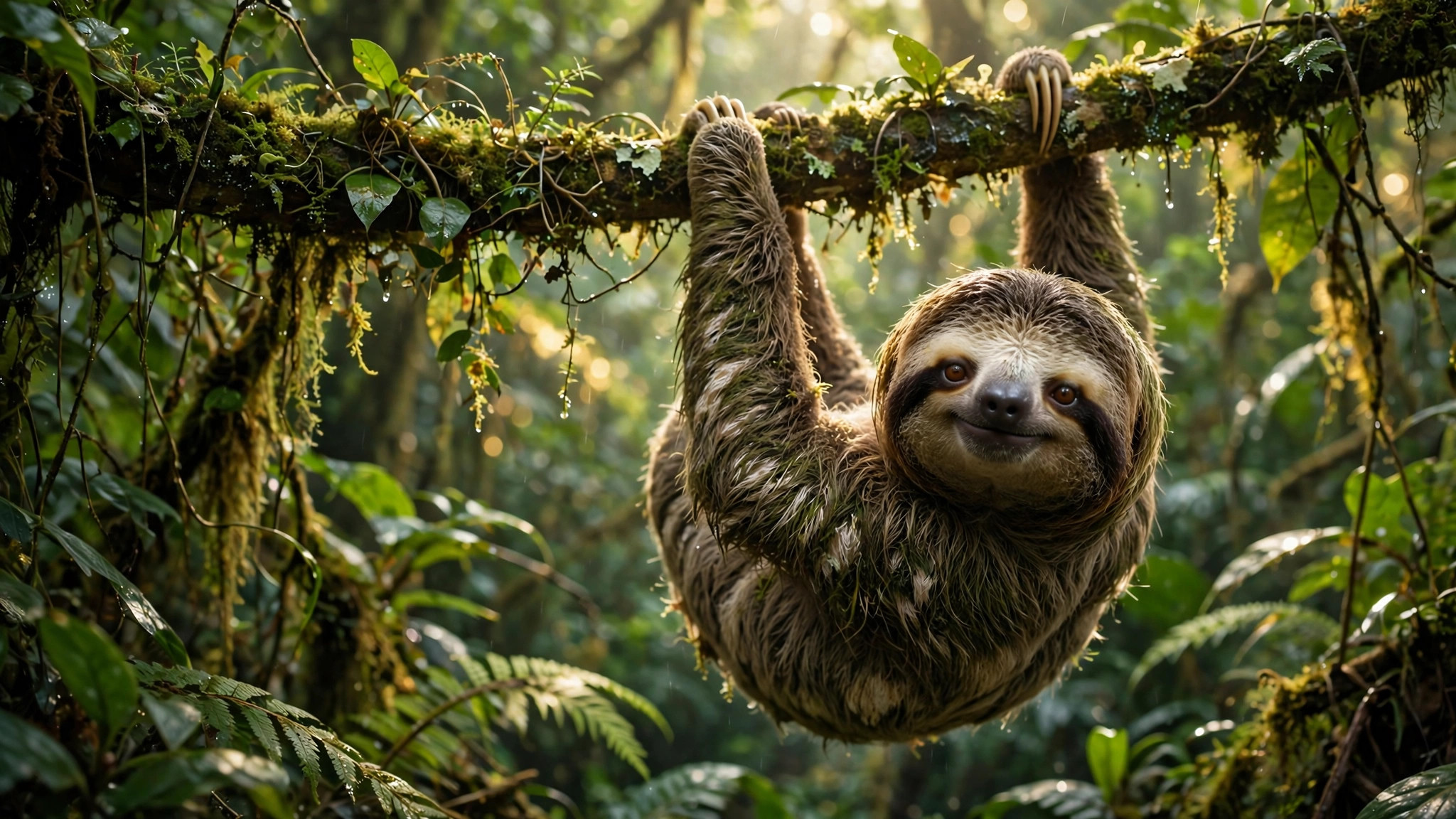
Who would choose a wallpaper of an animal that barely moves, and why does it calm a busy screen so well? Sloth wallpapers answer that question with a smile, showing where sloths live upside down in the canopy, when their slow pace matters most, and how a leaf diet and the lowest metabolism among mammals turned stillness into a survival strategy. What looks like laziness is careful energy conservation, and that is exactly what makes these backgrounds feel wise rather than dull.
Masters of Slow Living
Sloths are evolution’s minimalists. They live upside down, conserve energy as a lifestyle, and carry an expression often described as an eternal smile. Their image brings calm because the unhurried reads as profound, not empty.
As wallpapers, sloths deliver gentle tranquility. Sleepy faces, green-tinged fur, and the peace of the canopy suit screens that need to slow down. Where a dramatic animal image demands attention, a sloth quietly returns it.
That contrast is part of the appeal for collectors who also browse powerful big-cat imagery. A set that moves from Ultra HD Light Lion Wallpaper: Majestic 4K Backgrounds to a hanging sloth shows two opposite kinds of strength. One roars, the other endures.
Signature Styles, From Philosophers to Pygmies
The classic choice is the canopy philosopher. Three-toed sloths rest upside down like the forest’s slow thinkers, with facial markings, eye stripes, and that familiar smile. These are the most endearing portraits in the collection.
Baby sloths offer a tender alternative. Young sloths cling to their mothers, and sanctuary images add rescues, releases, and second chances. The mood is hopeful rather than sleepy, focused on slow care in the canopy’s nurseries.
Two styles surprise first-time viewers:
- Swimming sloths: river crossings where the slow animal moves three times faster in water.
- Pygmy islanders: the rare pygmy three-toed sloths, island dwarfs that are critically endangered and bound to mangroves.
- Two-toed portraits: the nocturnal, more active two-toed sloths, including Hoffman’s and Linnaeus’s, with differences in nose, habits, and night preference.
The pygmy images carry the most urgency. They show a miniature, mangrove-bound animal whose island protection is presented as the species’ hope. In a gallery, they work best where a smaller subject deserves closer attention.
The Science of Slow
The sloth’s strategy starts with food and metabolism. A leaf diet provides limited energy, so the lowest metabolism among mammals makes minimal movement an optimal choice. Scientific wallpapers explain the slow not as a flaw, but as an adaptation.
The fur deepens that story. Algae give the coat its green camouflage, while sloth moths of the Pyralidae live as residents in the fur. Together they turn the animal into a mobile ecosystem — a habitat, a garden, and, in the source’s phrase, a mobile salad.
The moth partnership completes the system. The moths’ lifecycle is tied to the sloth, with dung as the nursery and fur as the home. For readers who want the broader zoological context behind these traits, the overview of the sloth gathers the same themes of taxonomy and ecology in one place.
Even the weekly routine remains a puzzle. Sloths make a slow climb down for a bathroom break, abandoning canopy safety for a vulnerable moment on the ground. Theories involving fertilization, moths, and communication are still debated, which is why behavioral images feel like a mystery rather than a simple portrait.
Hidden Strength and Canopy Life
Slow does not mean weak. The sloth’s grip is tenacious, its curved claws hold the branch, and slow-twitch muscle efficiency helps explain the paradox of patient power. Strength here is sustained rather than explosive.
That strength sits inside a busy community. Monkeys, toucans, and harpy eagles share the canopy, and the harpy’s shadow makes stillness and camouflage a defense. A lighter, brighter big-cat option such as Dynamic White Lion Wallpaper: Majestic 4K & HD Backgrounds sharpens the contrast: the predator watches, the sloth survives by blending in.
Curating a set is easiest by mood. Choose philosophers for calm, babies for tenderness, swimmers for surprise, and pygmies for what feels precious. Four branches, one slow life, and a canopy that rewards patience.
There is also a philosophy attached to the animal. Reflective wallpapers present the sloth as a teacher and the canopy as a classroom, with slow living and presence offered as the lesson — the slow as the sane. The cultural icon that followed, through memes and merchandise, shows the sloth as a mascot and spirit animal whose resonance reaches far beyond the forest.
Sloth wallpapers endure because millions of years have vindicated the strategy. Energy was conserved, predators were avoided, and the canopy was held without joining the race. Choose your sloth, set it as your background, and keep a little of that slow wisdom in your day — some wallpapers decorate, but sloths teach, one unhurried moment at a time.
Related posts:


If these hit the mark, Chameleon Wallpapers: Masters of Disguise keeps the streak going with more majestic-animals picks.
Know someone whose screen needs a refresh? Pass this link along.

