
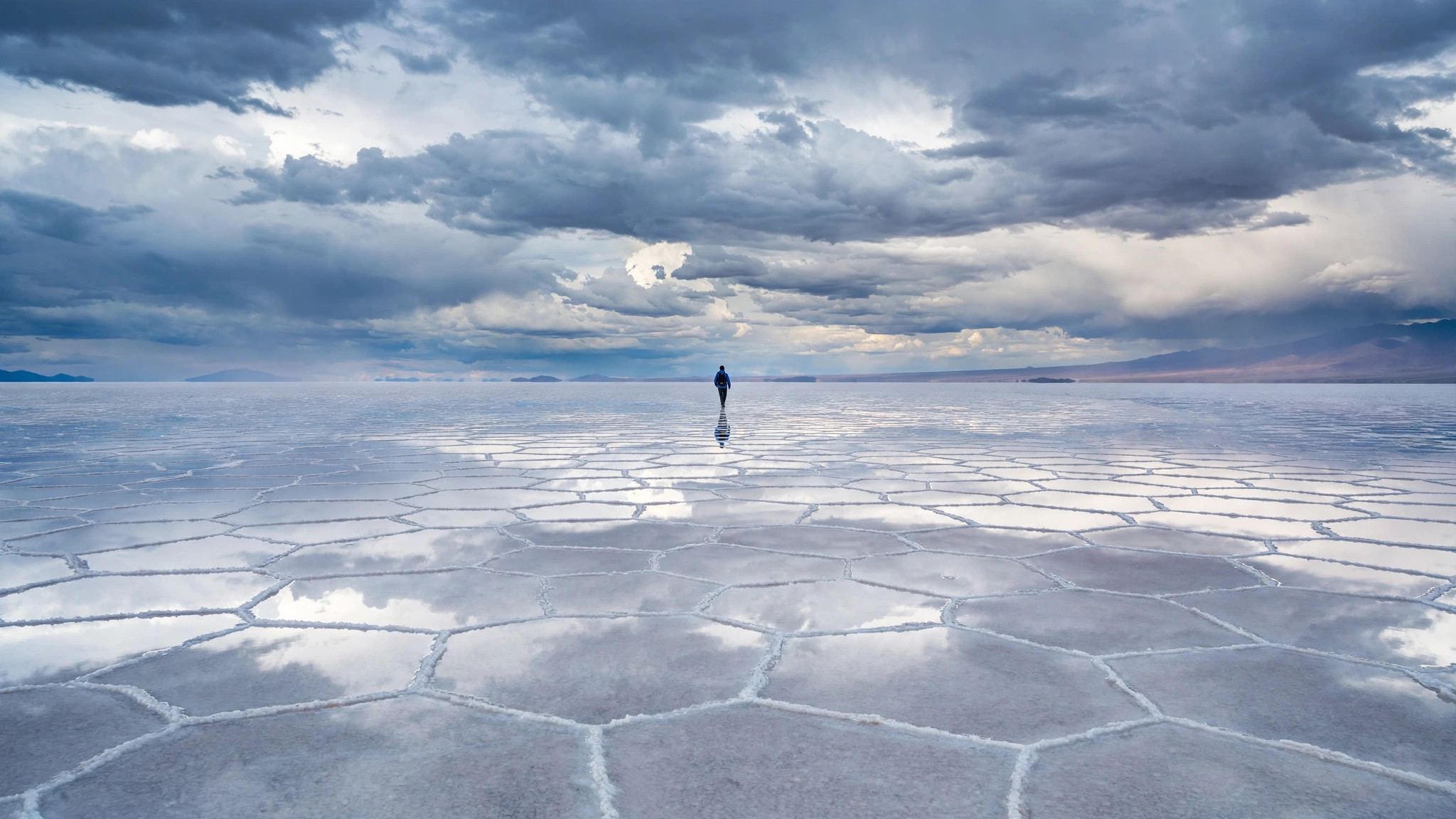
The ground becomes sky: a thin sheet of water turns the desert floor into a perfect mirror, clouds above and below, the horizon erased. Salt flat wallpapers capture mirrors of the sky for travelers, photographers, and dreamers who want the earth’s flattest places on a desktop or phone screen. Why do these white expanses photograph like infinity? Because a flooded salt pan doubles the world — and this guide shows how the great mirror, the polygons, and the doubled sunsets make such stunning backgrounds.
Mirrors of the Sky
Salt flats are the planet’s level: vast expanses of salt, flat to within centimeters over kilometers, the earth’s own mirror when wet. The photographs defy perception — the ground and sky trading places, the world turned inside out.
As wallpapers, salt flats deliver surreal minimalism. The endless white, the perfect reflections, the tiny human figures — these are backgrounds of infinite calm, for screens that need space.
Signature Salt Flat Styles
Four styles define the genre, divided by water and by hour. Each shows the flat wearing a different face.
- The great mirror — Salar de Uyuni after rain, the world’s largest mirror, with the sky doubled and the horizon gone.
- Polygonal earth — the dry season’s salt cracked into perfect hexagons, the earth as honeycomb.
- Sunset reflections — the golden hour doubled, the sun and clouds burning twice.
- Night mirrors — the Milky Way above and below, the salt flat as the sky’s twin.
The Great Mirror and Polygonal Earth
Salar de Uyuni after rain is the genre’s icon: the surreal made real, the infinite reflected. The perspective tricks — the toy cars, the giant boots, the people as gods — are the mirror’s playful gift, flatness turned into a funhouse.
In the dry season the flat shows its other face: salt cracked into perfect hexagons stretching to the horizon. It is the geometry of evaporation, nature’s tiling — the desert, tiled. For the opposite extreme of landscape drama, the high resolution mountain wallpaper for widescreen screens trades this flatness for towering height.
Sunset Reflections and Night Mirrors
The golden hour on the mirror is the genre’s most romantic hour: the sun doubled, the clouds in duplicate, the world burning twice. At full resolution these doubled sunsets show the magic undiminished — the fire, mirrored.
At night the stars double too, the Milky Way reflected in the salt until the cosmos appears twice. Where mountain landscapes show the earth’s heights, the night mirrors show its depths of reflection — the sky, grounded.
The Salt’s Story: Lakes, Life, and Harvest
The flats are ancient lakes: the water gone, the salt remaining, the minerals of millennia concentrated. These geological images tell the deep story — the lake’s ghost, the salt’s memory.
Life persists on the salt: flamingos in the shallow lagoons, foxes crossing the white, hardy plants at the edges. The flamingos’ pink comes from the brine shrimp, the food chain’s pink link, while vicuñas and Andean geese complete the cast of specialized survivors — the extreme as home.
Humans harvest the white too: the salt piles, the workers’ mounds, an ancient industry where salt is livelihood and the white is wages. The salt hotels, built of salt blocks with salt furniture, turn the harvest into architecture — the flat made habitable, the white constructed.
The Lithium Triangle and the Flats at Play
Beneath the salt lies the white gold: lithium brines, evaporation ponds in impossible greens, yellows, and blues — chemistry as art. The ancient lakebed now powers the battery age, adding a modern chapter to the salt’s story.
These industrial images carry weight, because the extraction raises questions of water, communities, and sustainability. The green future has a footprint, and the documentary wallpapers examine the tradeoffs honestly.
The flat is also a stage: salt flat marathons, land-speed records, and festivals on the white, with runners and racers crossing the infinite as arena. The Dakar’s passage — the rally crossing the white, dust on the salt, competitors as tiny bright insects — is the most dramatic of all: the flat as the ultimate test, the white as the judge.
Dawn, Solitude, and the Endless Horizon
The first light is the flat’s gentlest hour: the salt glowing pink, the long shadows, the harsh white softened into intimacy. Photographers wait in the cold with their tripods for exactly this — the early alarm and cold fingers behind every perfect dawn shot.
The flat’s philosophy is the horizon as meditation: the infinite as therapy, the white as the mind’s blank page, the salt flat as a zen garden writ large. Solitude seekers — the walkers, the sitters, the ones who came for the emptiness — find the space to be small and the white to be quiet in.
Curating Your Flat
Build your salt flat collection by water: great mirrors for the surreal, polygons for the geometric, sunsets for the romantic, night mirrors for the cosmic. Four flats, one infinite reflection. A softer contrast lives in the ultra HD white rose wallpaper, where white turns delicate instead of vast.
Salt flat wallpapers endure because they show the world doubled — the earth as mirror, the sky as twin, the infinite reflected in a sheet of water on salt. Some wallpapers decorate; salt flats reflect — the sky, the earth, and everything between.
Related posts:


Still browsing? Fjord Wallpapers: Cliffs and Cold Water is another collection worth a look — fresh picks in the same spirit.
Know someone whose screen needs a refresh? Pass this link along.

