
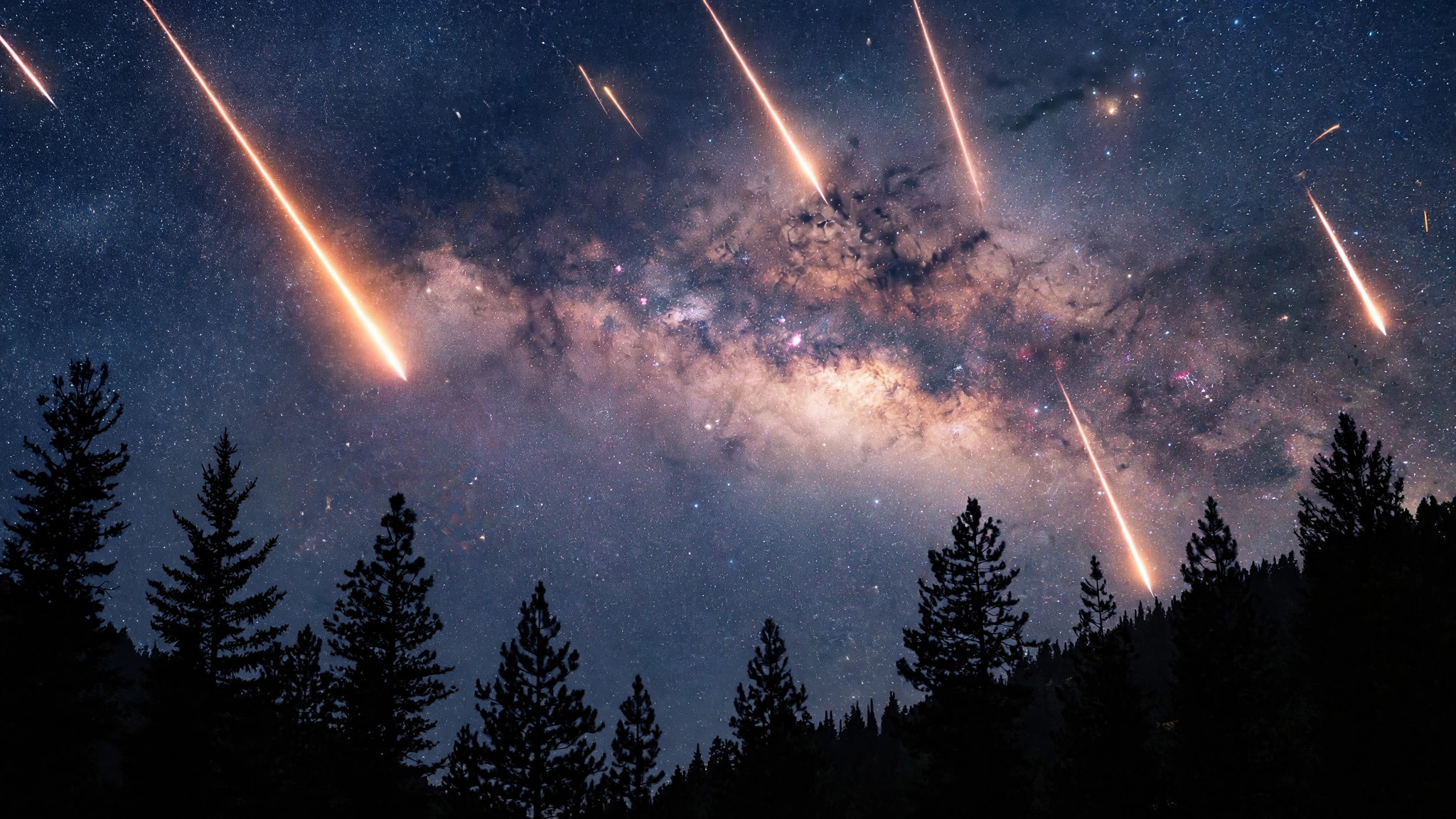
The sky catches fire in streaks: meteors blazing overhead, wishes made on falling stars, the cosmos putting on its most romantic show. Meteor shower wallpapers capture wishes in motion for stargazers who want the night sky’s fireworks on a phone or desktop screen, in any season of the year. Why do falling stars hold such power over us? Because a meteor shower is the clockwork of wonder — Earth’s annual passage through cometary debris — and this guide shows how Perseid peaks, lone fireballs, and radiant geometry freeze that fleeting light forever.
Wishes in Motion
Meteor showers are the sky’s scheduled spectacles: the Earth’s annual passages through cometary debris, arriving on predictable dates. The photographs freeze the fleeting — the streaks that last a second, preserved forever.
As wallpapers, meteor showers deliver cosmic romance. The dark sky, the bright trails, the landscape anchoring the celestial — these are backgrounds of wishful wonder, for screens that dream.
Signature Meteor Styles
Four styles cover the shower’s moods, from the crowded peak to the single brilliant streak. Each freezes a different kind of wish.
- Perseid peaks — the August classic: rich displays on warm nights, meteors thick as rain.
- Geminid fire — the December king: bright, colorful meteors on cold nights, winter’s best show.
- Lone fireballs — the great individuals: one brilliant meteor outshining the rest, the sky’s solo.
- Radiant points — the geometry of meteors tracing back to their radiant, stacked into composite masterpieces.
Perseids and Geminids
The Perseids are summer’s fireworks: the rich display and warm nights of the August peak, rendered trail by trail in high resolution. Lovers of deep-sky imagery will find the same cosmic mood across the space galaxy wallpapers collection.
The Geminids answer in December with bright, colorful meteors — the winter’s best show, the cold nights and hot streaks. The winter, ignited.
Fireballs and Radiant Points
The lone fireball celebrates the exceptional: the single brilliant meteor, the one streak that makes the night. It is the wish, magnified.
The radiant images show the shower’s structure instead — meteors tracing back to the constellation that sources them, the sky’s perspective made visible. The composites, stacking a whole night’s meteors into one frame, are the genre’s masterpieces: the shower’s full glory, time-compressed.
The Debris’ Tale and the Shower’s Calendar
Each meteor is a messenger: cometary dust, ancient debris, the solar system’s leftovers burning up. The parent comets — the Swift-Tuttles, the Tempel-Tuttles — are the showers’ sources, and the Earth keeps its annual appointment with their trails.
The calendar spreads the appointments across the year: the Quadrantids’ January fire, the Lyrids’ April grace, the Eta Aquariids’ May dawn, the Delta Aquariids’ July double. The dedicated chasers plan vacations around the peaks and drive to dark skies for the maximum — the reclining chairs, the thermoses, the counted meteors.
The science explains the magic: ablation, ionization, light from heated air as a dust grain meets its fiery end in the atmosphere’s canvas. The recovered meteorites are the shower’s solid cousins — the stones that survived, the irons from the belt, the Martian rocks — the sky made holdable, the wish weighted.
Great Storms and Ancient Omens
Sometimes the shower becomes a storm: the legendary 1833 Leonid storm, the 1966 outburst with thousands per minute, the sky falling in earnest. These historical images recall the nights the heavens opened — the storm as the shower’s apotheosis.
The predicted returns keep the hope alive, including 2031’s promise and the calculations behind it. The heavens, punctual.
The ancestors read the streaks differently: as omens, dragons, celestial messages — the sky speaking, the gods signaling. Yet the cultural wishes, from the Italian stars to the varied traditions, prove the response is universal: the streak seen, the wish made, the hope launched.
The Watchers and the Morning After
Today the sky is monitored: camera networks, citizen scientists, and triangulated trajectories make modern meteor science a shared watch. The great recoveries are its triumphs — fresh falls found, orbits calculated, parent bodies identified — the streak tracked, the stone found, the story complete.
Every shower ends at dawn: the radiant setting, the meteors fading, the sky lightening, the last meteor handing over to the first light. The morning after is the epilogue — counted meteors, photographed fireballs, wishes tallied and banked — while the observers sleep and dream of the next shower.
For the same night sky shrunk to a pocket screen, the high res space wallpaper options for iPhone carry these streaks anywhere.
Curating Your Shower
Build your meteor collection by shower: Perseids for the summer, Geminids for the winter, fireballs for the drama, radiants for the geometry. Four streaks, one wishing sky.
Meteor shower wallpapers endure because they show the cosmos winking — the brief bright streaks, the ancient debris, the wishes we can’t help making. Some wallpapers decorate; meteors grant — one wish at a time, streaking.
Related posts:



If these hit the mark, Hubble Telescope Wallpapers: Eyes on the Universe keeps the streak going with more 4k-space picks.
Know someone whose screen needs a refresh? Pass this link along.

