
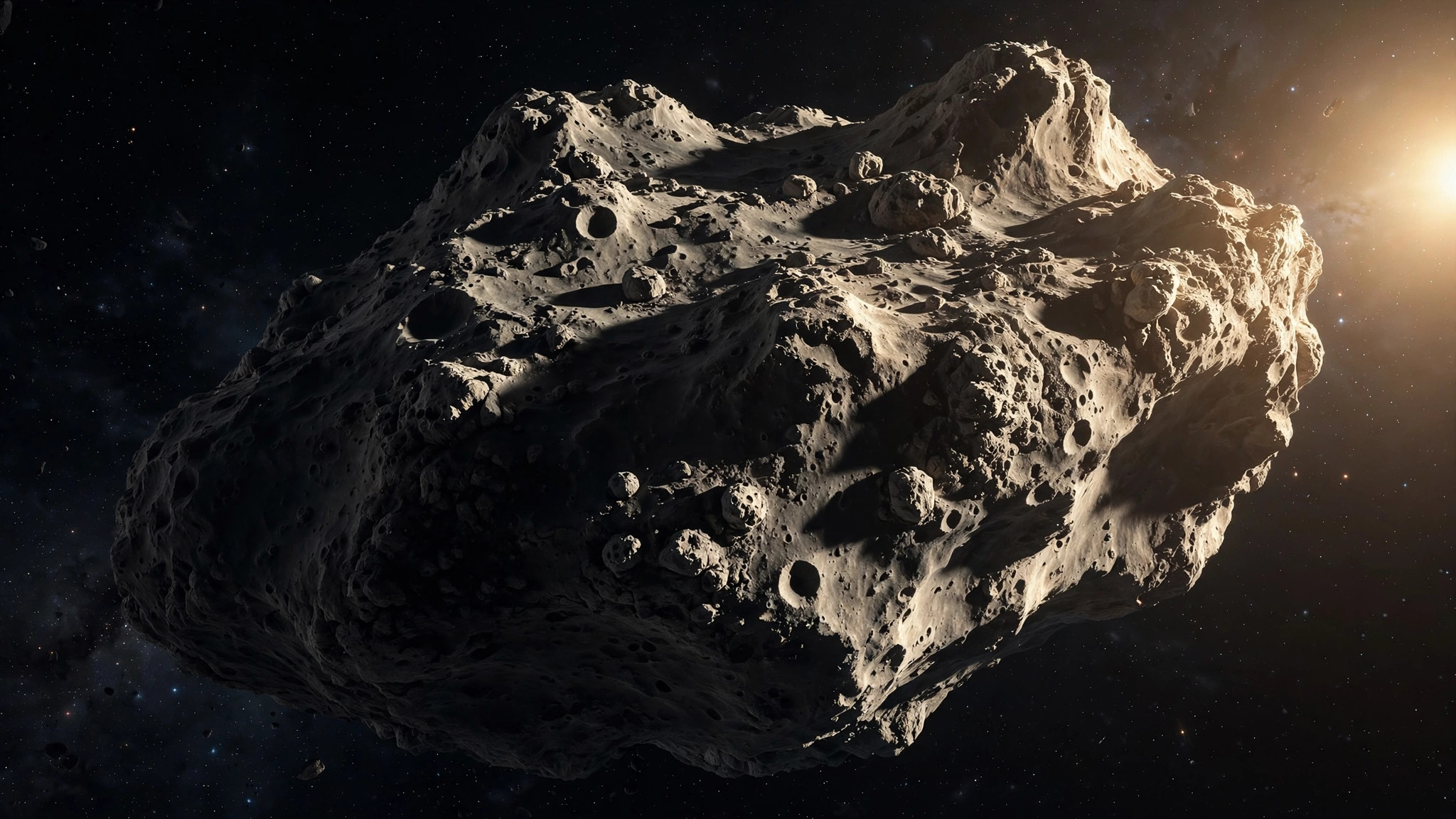
What are asteroids, where did they come from, and why do tumbling rocks deserve a place on a modern screen? Asteroid wallpapers answer by showing the solar system’s leftover building blocks — planetesimals that never became planets, formed 4.6 billion years ago and still carrying organic molecules. Who studies them, how missions sample them, and when a near-Earth visitor changes from curiosity to planetary defence are all part of the story.
Rocky Wanderers and Visited Worlds
Asteroids are the solar system’s fossils. They are planet formation’s leftovers and witnesses to how the system began, so their image carries the primordial. As wallpapers, they deliver cosmic geology in cratered surfaces, tumbling motion, and black backgrounds.
The most tangible images come from visited worlds. Eros, Itokawa, Bennu, and Ryugu have moved from points of light to real places with surfaces that missions could approach. Sample returns by OSIRIS-REx and Hayabusa2 make those portraits the most scientific in the set.
Readers building a wider cosmic gallery often start with phone-ready space imagery. A guide such as High Res Space Wallpaper: Best 4K Options for iPhone suits the broad view, while asteroid close-ups reward a taste for stone and shadow. The two moods complement each other without competing.
The Belt, Its Types, and Its Odd Residents
The main belt holds millions of rocks. Ceres and Vesta anchor the multitude, and the Dawn mission’s visits revealed Vesta’s snowman feature and Ceres’ bright spots in detail. Belt wallpapers present that population as an archive of a failed planet’s fragments.
Composition divides the archive into families:
- Carbonaceous asteroids: part of a diversity that also includes silicaceous bodies, noted for organics such as amino acids and water.
- Metallic M-types: exposed-core worlds such as Psyche, linked to mining dreams and trillion-dollar speculation.
- Binary asteroids: paired rocks with moonlets, formed through spin and fission, including the Didymos pair struck in the DART test.
- Trojans and centaurs: Jupiter’s co-orbital companions in Greek and Trojan camps, and hybrid asteroid-comets such as Chiron that cross between categories.
The Trojans carry the most charming naming story. Their camps borrow the Iliad as a directory, with heroes lending names to rocks, and the Lucy tour’s multiple flybys are framed as a parade of fossils. Centaurs, by contrast, surprise through distant outgassing where a rock begins to behave like a comet.
Artistic visions take a different route. Imagined asteroids use dramatic lighting to make stone feel sublime, and mining visions push the same rocks toward a future of resources. Reference summaries of the asteroid help separate those imagined scenes from the visited worlds above.
Near-Earth Visitors, Impacts, and Fallen Messengers
Near-Earth asteroids are the neighbours. Tracked rocks and close approaches make them the most relevant subjects, and the DART impact — a deflection test that changed an orbit — is presented as the most historic moment. These wallpapers show wanderers being watched, and in one case, nudged.
The deeper story is impact. Asteroids are linked to the dinosaurs’ end and the cratered Moon, to cosmic billiards played across deep time. Fiction extends that power through disaster films and mining futures, turning the asteroid into an archetype and a warning.
A broader backdrop collection such as Space Galaxy Wallpapers: A Guide to Cosmic Backgrounds places that drama against stars and nebulae. Asteroid images stay closer and older, focused on a single rock’s surface. Both approaches honour deep time at different distances.
Meteorites bring the story within reach. Fallen asteroids become museum pieces and touchable space, completing a path from belt to fall to find. Witnessed falls, fireballs, recoveries, and traced orbits make arrival images the most thrilling of all.
Why the Wanderers Endure
Curate the belt like the missions do. Choose visited worlds for the real, the belt for the multitude, near-Earth asteroids for the neighbours, and art for the sublime. Four orbits hold one rocky history, from Psyche’s anticipated metal world to the belt’s invitation of millions of unexplored rocks.
Two details sharpen the belt’s character. Chiron’s discovery is remembered as the first centaur and the birth of its category, the moment a hybrid was recognised and the crossing was classified. The Psyche mission, meanwhile, is the most anticipated metal-world visit, promising a core revealed rather than merely imagined.
The organics give the rocks their deepest significance. Amino acids and water carried by asteroids are described as life’s ingredients, so the wanderers appear as seeders and givers rather than inert debris. That cargo is why composition wallpapers feel profound instead of merely geological.
That invitation is the closing idea. The belt’s rocks are described as the solar system’s diary, with untouched surfaces and 4.6 billion years of history waiting to be read. Asteroid wallpapers endure because they show the system’s memory — choose your asteroid, set it as your background, and keep a little primordial stone in your day, one crater at a time, for eons.
Related posts:

Collections like this one connect to a bigger 4k-space library — Blue Marble Wallpapers: Planet Earth From Space is a good thread to pull next.
Know someone whose screen needs a refresh? Pass this link along.

